Builders
 Carpenters
 Electricians
 Flooring Specialists
 Gardeners
 Handymen
 Heating Engineers
 Painters & Decorators
 Plasterers & Renderers
 Plumbers
 Roofers
 Tilers
 my
myCost of Light Fixtures and Fittings
At a Glance
- The average cost of a new light installation is around £100.
- The job will take approximately 2 to 3 hours to complete.
- A complete lighting installation pricing breakdown by type, including like-for-like replacements and new installations.
- The time it takes to change a light fitting.
- Tips for choosing the right light fitting for your space.
- How to use MyJobQuote to find and hire a local electrician to fit new lights.
Get free estimates
Are you a trade? Get more work today!
How much does it cost for an electrician to install a ceiling light in the UK?
The average cost of installing light fixtures will typically be around £100 depending on the complexity of the job and other factors.
There are a whole range of home lighting options available to choose from, such as kitchen light fittings, ceiling light fixtures, bedroom light fixtures, and many more. Determining what's right for you can be overwhelming, with variations in price, light quality, and brightness to consider.
Are you ready for a quote?
We have a wide range of electricians near you who are ready to give you a free, no obligation quote!
If you're curious how much new lighting features may cost to install, keep reading to discover local electrician fees, material costs, and more.
£100
Table of Contents
How Much Does It Cost to Change a Light Fitting?
Want to find out how much light fittings cost to install?
For a simple like-for-like replacement, such as changing one existing light fixture for a new light fixture, you can expect costs of £100 for combined material and labour costs, with the entire job taking around 1 hour to complete. This is a fairly simple job for an electrician to complete, but if your home has old electrical wiring, or the existing light fitting is hard to access, you can expect labour costs to increase with the additional time needed.
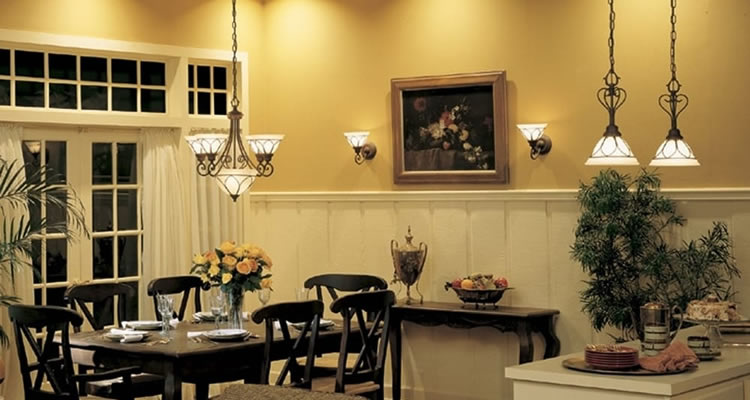
Adding a chandelier or pendant light can transform a space, adding a focal point. Depending on the type of light fitting you choose, you can expect supply costs of around £80 to £400+, together with labour costs of £80 or more for an electrician's fitting fees.
These costs assume you're looking to install a ceiling light with existing wiring, which is what most jobs involve. Complete lighting renovation costs are much higher than those of simple replacements.
We want a ceiling light swapped. I had a look myself and there are a lot of wires attached to the current light fixture. How much would this cost?
"A local electrician would normally charge £40 to £50 to replace the fitting dependant on time and travel."
New Internal Light Fixture Installation Costs
Let's take a closer look at some light fitting supply and installation costs, considering different light bulb fittings.
Spotlights and downlights are a great way of adding a sleek, modern feel to rooms, while adding extra light in specific locations. The cost of installing spotlights and downlights ranges from £300 to £500 for supply and installation, taking between 2 and 4 hours to complete depending on the job's complexity and ease of access.
| Job Description | Duration | Material Cost | Labour Cost |
|---|---|---|---|
| Ceiling or Wall Lamp Replacement | 1 hour | £20+ | £50 |
| New Single Lightweight Pendant/Chandelier With No Extra Wiring | 1 hour | £80 | £50 |
| 6 Lamp Lighting Grid in the Kitchen With New Wiring | 4 hours | £650 | £250 |
| 4 Dimmed Wall Lights in the Living Room | 2 to 3 hours | £250 | £175 |
| Downlight/Spotlight Installation in One Room (6 to 8 lights) | 2 to 4 hours | £20–£75 | £300–£600 |
Want a custom price?
Post your job
How Much Does It Cost to Replace a Light Fitting?
A like-for-like light fitting replacement is the most common lighting job in UK homes. This is where an existing ceiling or wall light is removed and replaced with a similar fitting using the existing wiring and ceiling point.
Because no new wiring is required, this is usually a quick job for a qualified electrician and is often charged as a minimum call-out or hourly rate rather than a full installation fee.
The typical cost to change a light fitting is £40 to £80 per fitting (labour only), and the job takes between 30 and 60 minutes. The cost of the light fitting itself varies considerably depending on the style, but basic, budget-friendly ceiling lights start at around £10.
What is a like-for-like replacement?
Simple, low-cost replacement light fitting jobs include:
- Swapping a ceiling rose for a pendant light.
- Replacing an old wall light with a new one of the same type.
- Changing a damaged light fitting for an identical replacement.
In many cases, electricians will reduce the cost per light when multiple fittings are changed in one visit, which is why homeowners often replace several at once rather than individually.
Below are examples of common light fitting replacements where existing wiring is already in place:
| Job Type | Duration | Labour Cost | Total Installed Cost |
|---|---|---|---|
| Replace ceiling pendant with similar fitting | 30 to 60 mins | £40–£80 | £60–£120 |
| Swap wall light (same position & wiring) | 30 to 60 mins | £40–£80 | £60–£130 |
| Replace broken light fitting (like-for-like) | 30 to 60 mins | £40–£90 | £60–£140 |
| Change multiple fittings (2 to 5 lights in one visit) | 1 to 2 hours | £70–£150 total | £100–£250 |
| Replace old ceiling rose with pendant light | 30 to 60 mins | £40–£80 | £60–£120 |
Want a custom price?
Post your job
How Much Does It Cost to Move a Light Fitting?
Moving a light fitting to a new position in a room is more complex than a simple replacement, because it involves altering the existing wiring route rather than just swapping the fitting itself.
This type of job is common when homeowners want a ceiling light centred in a room, repositioned over a dining table, or moved to better suit a new layout.
The typical cost to move a light fitting is £120 to £250 per fitting.
The final price depends on how far the fitting needs to be moved and how easy it is to access the ceiling void. Quotes usually also include making good afterwards, and testing and certifying the altered circuit, which is why costs can be higher than simple replacements or new installations where the wiring already exists.
New External Light Fixture Installation Costs
While you have an electrician at your property, it's cost-efficient to schedule multiple electrical changes at the same time if you know you have upgrades you want to make. This will help to negate any further call-out fees or extra fees for small jobs when you can roll them into one slightly larger project.
Adding external lights to your property can help with security while providing lighting for hosting and entertaining. Outdoor floodlights cost as little as £4 to £80 each, with labour costs of around £100.
If you want to up your outdoor security game further, outdoor motion activated lights cost between £90 and £500 for supply and installation, helping to alert you to any potential unwanted visitors.
You may want outdoor soffits installed to brighten up your property's exterior or enhance architectural features. The cost of outdoor low-voltage soffits ranges from £270 to £400 for supply and installation, depending on the volume of lights and the complexity of the installation.
Lastly, while external lighting is our main focus, installing a few outdoor plug sockets can give you an easy electrical supply for lawnmowing and other outdoor tasks. Outdoor socket installation costs £10 to £15 per single socket, with £75 to £185 added on in electrician fees to fit and install the sockets.
| Job Description | Duration | Material Cost | Labour Cost |
|---|---|---|---|
| Outdoor Floodlight Installation | 1 hour | £4–£80 | £100 |
| Outdoor Spotlight Installation | 1 hour | £8–£400 | £100 |
| Low-Voltage Exterior Light Installation | 2 to 4 hours | £120–£200 | £150–£200 |
| Outdoor Single Socket Installation | 1 to 2 hours | £10–£15 | £75–£185 |
Want a custom price?
Post your job
How to Choose the Right Light Fittings
With so many light fittings on the market, deciding what's best for your home can be overwhelming. To help you choose, you should consider:
- What's the Purpose of the New Lighting? — Is it purely decorative, or is it providing a functional benefit?
- Do You Have a Current Lighting Style? — If your home already has a distinct style, such as ultra-modern spotlights, you'll want to keep your lighting upgrades within the same style family.
- Are You Swapping Like-for-Like Light Fittings or Requiring Extensive Rewiring? — The former will give you lower labour fees, while the latter will raise your labour costs.
Here's a look at the different types of light fittings available:
Ceiling Lights
- Typical Cost — £20 to £120 (supply), £100 to £180 installed depending on complexity.
- Best For — General lighting in bedrooms, living rooms, hallways, and kitchens.
Ceiling lights are the most common type of light fitting and come in a huge range of styles, from basic flush fittings through to more decorative designs. In most cases they are a straightforward like-for-like replacement using existing wiring, making them one of the most cost-effective options.
Pros & Cons
- ✔ Wide range of styles and price points available.
- ✔ Usually quick and simple to replace.
- ✔ Cost-effective compared to more complex lighting systems.
- ✖ Can feel plain in larger or more design-led interiors.
Chandeliers
- Typical Cost — £80 to £400+ (supply), £120 to £300+ installed depending on weight and wiring.
- Best For — Dining rooms, hallways, and feature lighting in high-ceiling spaces.
Chandeliers are designed to act as a focal point and are often used in rooms where you want a more decorative or luxury feel. They are more complex than standard fittings and may require additional support depending on size and weight. They are not suitable for homes with lower ceilings.
Pros & Cons
- ✔ Strong visual impact and decorative focal point.
- ✔ Works well in larger rooms and high ceilings.
- ✔ Wide range of traditional and modern designs.
- ✖ Heavier and more complex to install than standard fittings.
Track Lighting
- Typical Cost — £80 to £300 (supply), £200 to £450 installed.
- Best For — Flexible lighting in kitchens, open-plan spaces, and living areas.
Track lighting allows multiple light heads to be positioned along a single track, giving you flexibility to direct light where it's needed most. It's often used in modern interiors where adjustable lighting is a priority.
Pros & Cons
- ✔ Flexible and adjustable lighting setup.
- ✔ Good for highlighting specific areas or features.
- ✔ Modern, minimal design.
- ✖ Can feel industrial in more traditional homes.
Spotlights
- Typical Cost — £100 to £500 per room installed (depending on number of fittings).
- Best For — Kitchens, bathrooms, hallways, and modern living spaces.
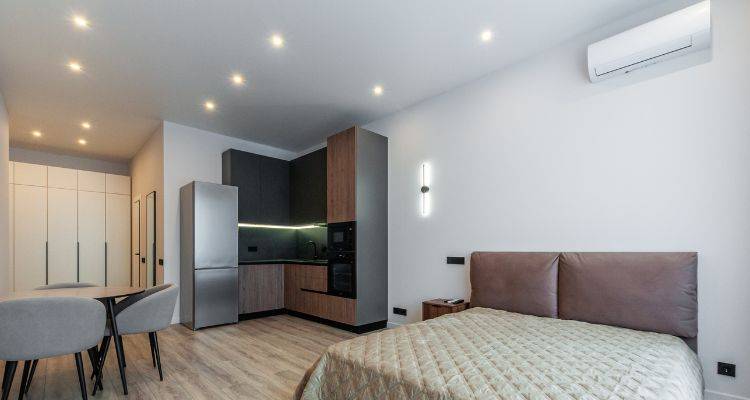
Spotlights are often used for task lighting or to create a clean, modern finish. They are particularly popular in kitchens and bathrooms where directional light is useful, but they require more planning and installation work than simple ceiling fittings.
Pros & Cons
- ✔ Clean, modern, unobtrusive design.
- ✔ Great for task lighting and focused illumination.
- ✔ Works well with dimmers and smart systems.
- ✖ Requires more invasive installation than surface fittings.
What's the rough cost to install 2 light fittings in the lounge / diner?
"2 light fittings for £80. If it was a chandelier or a larger pendant would be more."
Key Things to Consider Before Installing New Light Fittings
- Are you simply replacing a fitting or adding new wiring? A like-for-like swap is straightforward and usually quick. If you're installing new fittings in different positions or adding wiring, the job becomes more complex and may require sign-off under Building Regulations (Part P).
- What IP rating do you need? Lights used in bathrooms, kitchens, or outdoor areas must have the correct IP (Ingress Protection) rating. For example, bathroom fittings should generally be rated IP44 or higher for safety.
- How bright should the lighting be? Think about the size and function of the room. Kitchens and offices need brighter task lighting, while living rooms benefit from softer, layered light using multiple fittings or dimmers.
- Would LEDs or smart lighting make sense? LED fittings use less power and last longer. Smart bulbs and dimmer systems can help you control the level of light better, but check that they're compatible with your existing wiring and switches.
- Is there access to the ceiling void? For downlights and new wiring, electricians need space above the ceiling. Restricted access or heavy insulation can add time or limit placement options.
- Could there be hidden issues? Old or damaged wiring, awkward access, or outdated junction boxes can extend the work. Ask your electrician to inspect before quoting to avoid surprises. If you need new wiring, or a complete electrical home rewire, you can expect your labour costs to rise, with the cost of home rewiring ranging from £5,500 to £7,000 for a semi-detached house.
- Do you want long-term energy savings? Switching to LED fittings could save a typical household around £45 a year on lighting costs. While the upfront cost can be higher, LEDs use around 80% less electricity than halogens and last up to 20 times longer.
- Do you want smart lighting? Many homeowners are now considering smart bulbs due to their convenience and efficiency. It typically costs more, but offers features like automatic scheduling, motion sensors, and dimming from your phone, though smart bulbs alone are unlikely to cut energy use significantly.
- Is your installer qualified and certified? For any work beyond a simple like-for-like replacement, use a qualified electrician registered with a competent person scheme such as NICEIC or NAPIT. They'll ensure the job is tested, safe, and compliant.
I would like to know how much does it cost to install recessed down lights in a room? The existing light fittings are standard pendant lights.
"Any access for wiring from the loft for an upstairs room is easier. For a downstairs room, either lifting of the floor boards above the room for access for wiring or a small chase in the ceiling has to be carried out. For a room with 8 fire rated, good quality down lights, and dimmable lamps the cost would be approximately £250."
Can I Change Light Fittings Myself?
Do I need an electrician to replace a light fitting?
Most of us are comfortable changing light bulbs and shades, but replacing an entire light fitting is a more complex job. A simple like-for-like swap may be possible for confident DIYers, but even this carries some risk, and anything involving new wiring, switches, or ceiling access is best left to a qualified professional.
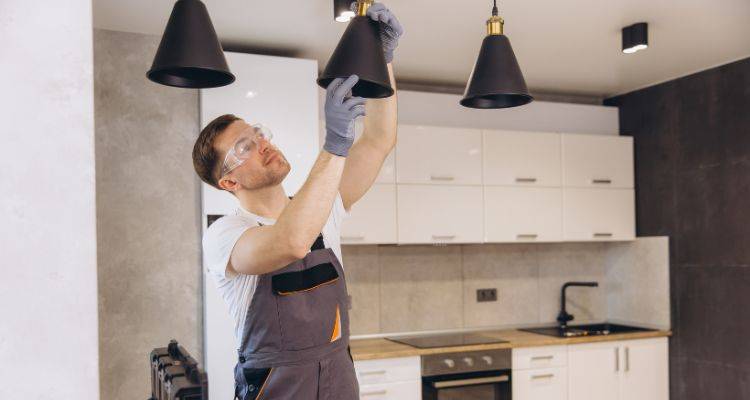
A professional installation helps:
- Keep Your Home Safe and Compliant — Electricians follow UK wiring regulations and Part P of the Building Regulations, reducing the risk of electric shock or fire.
- Ensure the Work Is Properly Tested and Certified — A qualified installer can issue the correct documentation, protecting you if you later sell or rent the property.
- Spot and Fix Hidden Wiring Issues — Professionals can identify overloaded circuits, damaged cables, or unsafe connections before they cause problems.
- Protect Your Warranty and Insurance — Manufacturers and insurers may require electrical work to be carried out by a certified tradesperson.
LED spotlights or downlights can add a sleek, modern finish to any room, but a poor installation can spoil the look and create safety risks. For the best results, it's best to leave this type of work to a qualified electrician.
Can I control living and dining room lights separately? I have one switch for both areas but want two. How much work and cost to install separate switches?
"You wouldn't need to install two separate switches just replace the existing 1-way switch for a 2-way switch. Hire a competent electrician to do this minor work. Expect to pay no more than £60 to £80, not including materials."
Checklist: How to Find and Hire an Electrician in the UK
Consider these key points before hiring an electrician for the job:
- Are they qualified and registered? Electricians should be fully qualified and ideally registered with a UK competent person scheme such as NICEIC or NAPIT. This confirms they meet current electrical safety standards and can self-certify their work.
- Do they have valid insurance? Always check that your electrician has public liability insurance. This protects you in case of accidental damage or injury during the job.
- Will they provide the necessary certification? An electrician should carry out safety tests and issue a BS 7671 certificate for every job. If the work has to be notified under Part P of the Building Regulations, you should also receive a separate Building Regulations compliance certificate.
- What exactly is included in the quote? The quote should clearly list labour, materials, call-out fees, and any extra costs for new wiring, fittings, or smart controls. Ask for a fully itemised breakdown so there are no surprises later.
- Have they completed similar work before? Ask for photos or examples of previous lighting installations. Experience with the type of fitting you're having installed (for example, downlights, pendants, or outdoor lighting) helps ensure a smoother job.
- Do they have positive reviews or references? Check feedback on MyJobQuote. Consistent comments about punctuality, neatness, and professionalism are a good sign.
- Will they handle waste removal and clean-up? Confirm whether they'll take away old fittings, packaging, and wiring offcuts once the work is complete.
- What guarantees do they offer? Most reliable electricians provide a guarantee for their workmanship and warranty coverage for parts or fittings used.
- Have you agreed payment terms in writing? Before work begins, confirm when payments are due, whether deposits are required, and if payment is contingent on completion or certification.
It's always worth speaking with a few different electricians and comparing their prices before making a hiring decision.
Even if the first offer you get seems reasonable, getting a few quotes from local electricians helps you weigh up your options when replacing or installing new light fittings.
Ask a Trade
Got a question that only a tradesperson can answer? We have thousands of trades ready to answer any question you may have.
Ask your question

FAQs
Do I Need Building Regulations Approval to Install New Light Fittings?
Usually not for a like-for-like replacement, but you will need to notify if the work involves installing a new circuit, replacing a consumer unit, or altering a circuit in a room with a bath or shower. Kitchens and outdoor areas are not included. A registered competent person electrician or your local building control body can sign off notifiable work.
Can a Handyman Change a Light Fitting?
Yes, a handyman can change a light fitting if it's a simple like-for-like swap such as swapping a ceiling rose for a pendant light. It's often cheaper to hire a handyman than a professional electrician for this type of work, but if new wiring is required, it's better to hire an electrician.
Can I Mix Different Types of Bulbs in the Same Light Fitting?
It's best not to. Mixing bulb types or wattages can cause uneven lighting, flickering, or overheating. Always use the same type of bulb recommended by the manufacturer.
Will Dimmers or Control Systems Save Me Money?
Dimmers and control systems will contribute to cost savings on electricity bills if you adjust them correctly and only use as much power as necessary for the lighting effect you require.
Can I Use Smart Lighting or Dimmers with Existing Fittings?
Not all light fittings or circuits are compatible with smart bulbs or dimmer switches. Installing them incorrectly can cause flickering, reduced lifespan of bulbs, or wiring issues. A qualified electrician can advise on compatibility and safely install any smart lighting features.
Where Can I Install a Pendant Light?
Pendant lights are versatile and can be used in any room. However, certain types of pendant light fittings are suited to certain rooms better than others. Traditionally pendant light fittings are used in living rooms but they do look great when used elsewhere.
For example, in the kitchen pendants look good over your kitchen table or island, plus mini pendant lights look great in the dining room over the table.