Builders
 Carpenters
 Electricians
 Flooring Specialists
 Gardeners
 Handymen
 Heating Engineers
 Painters & Decorators
 Plasterers & Renderers
 Plumbers
 Roofers
 Tilers
 my
myOil Boiler Installation Cost
At a Glance
- The average new oil boiler cost (installed) is around £3,300 in the UK.
- Most new oil boiler installations take 1 to 4 days to complete.
- New oil boiler installation costs in 2026, by type and brand.
- How long the job takes and what's involved in installing a new oil boiler.
- How to find a heating engineer using MyJobQuote.
Get free estimates
Are you a trade? Get more work today!
Looking into how much an oil boiler installation costs in the UK?
In 2026, the average cost of an oil boiler replacement is £3,300. However, oil boiler costs are impacted by factors such as the size of the boiler, how complex your central heating system is to work, and your location in the UK.
In this oil boiler cost guide, we cover everything that you need to know. This includes typical oil boiler prices in the UK, how much a heating engineer will charge for installing an oil boiler, and much more!
Ready to get a quote?
MyJobQuote can help you find a heating engineer near you who can install an oil boiler. Get up to 3 FREE, no obligation quotes for how much oil central heating costs in your specific circumstances.
Want to learn more about oil boiler costs first?
Check it out below!
£3,300
Table of Contents
- How Much Does a New Oil Boiler Cost?
- Oil Boiler Supply Costs
- Labour Cost to Install an Oil Boiler
- Factors Affecting Oil Boiler Installation Costs
- Additional Oil Boiler Installation Costs
- Oil Tank Installation Cost
- Oil Boiler Running Costs
- Alternatives to Oil Boilers
- Key Things to Consider When Installing an Oil Boiler
- Types of Oil Boiler
- Can You Install an Oil Boiler Yourself?
- Checklist: How to Find and Hire an Oil Boiler Engineer in the UK
- FAQs
How Much Does a New Oil Boiler Cost?
Installing an oil boiler can cost anywhere between £2,200 and £5,500. This price depends on:
- The type and size of oil boiler.
- The OFTEC-registered engineer's daily rate.
- The complexity of the installation (whether it's a like-for-like swap, or a brand-new installation).
Oil boilers are popular in off-grid properties where a standard gas connection isn't available.
Modern oil boilers will not only make your bills cheaper due to improved efficiency, but they'll also make your heating more effective.
Can an oil boiler be used off grid?
"The oil boiler will need a power supply and you will need the oil delivered into a tank on your property."
Oil Boiler Installation Prices
To start with, let's look at the total supply and installation costs for 4 different models of oil boiler:
| Oil Boiler Model | Total Estimated Cost |
|---|---|
| Warmflow Agentis Boiler House B26 26kW Condensing Regular Oil Boiler | £2,200–£2,800 |
| Firebird Envirogreen Kitchen C26 Internal Regular Oil Boiler | £2,700–£3,300 |
| Grant VortexBlue Kitchen/Utility 36kW Regular Oil Boiler | £3,200–£4,300 |
| Worcester Bosch Greenstar Heatslave II 18/25 Combi | £4,000–£5,500 |
Want a custom price?
Post your job
Oil Boiler Supply Costs
If you're thinking of buying your new oil boiler yourself and then hiring a professional to install it, you'll probably be interested in knowing the supply-only costs for different models.
What is your biggest concern when planning to install an oil burner?
Health and safety concerns
0 votes - 0%0% of votes
Cost of the boiler and installation fees
7 votes - 100%100% of votes
Fuel efficiency and running/maintenance costs
0 votes - 0%0% of votes
Reliability and performance
0 votes - 0%0% of votes

7 votes
See results
Hide results
The supply-only cost for your oil boiler will depend on its output (kW), boiler type (regular or combi), and manufacturer and model you choose.
Here are the individual oil boiler supply costs for the Warmflow, Firebird, Grant, and Worcester Bosch models for easy comparison:
| Oil Boiler Model | Supply Cost |
|---|---|
| Warmflow Agentis Boiler House B26 26kW Condensing Regular Oil Boiler | £1,300 |
| Firebird Envirogreen Kitchen C26 Internal Regular Oil Boiler | £1,900 |
| Grant VortexBlue Kitchen/Utility 36kW Regular Oil Boiler | £2,400 |
| Worcester Bosch Greenstar Heatslave II 18/25 Combi | £3,300 |
Want a custom price?
Post your job
Labour Cost to Install an Oil Boiler
Having bought your new oil boiler, to understand the total cost of installation, it will be helpful to know how much you need to budget for labour costs.
Oil boiler technicians charge between £300 and £550 per day. However, the total labour cost will depend on whether it's a like-for-like replacement or a brand-new installation and how complicated the installation will be.
Here are some estimated labour costs for a like-for-like oil boiler swap, as well as converting from another heating system:
| Installation Type | Typical Labour Cost | Typical Total Installed Cost |
|---|---|---|
| Like-for-like oil boiler replacement | £300–£1,100 | £2,200–£5,500 |
| Like-for-like replacement with boiler relocation | £600–£1,400 | £2,800–£6,000 |
| Switching from another heating system | £900–£2,200 | £3,500–£6,500 |
| First-time oil boiler installation | £1,000–£2,000 | £5,000–£8,000 |
Want a custom price?
Post your job
Factors Affecting Oil Boiler Installation Costs
We've briefly mentioned some of the factors that can affect the cost of your oil boiler installation. Here are the main reasons why some installations will cost more than others:
- Boiler Type — Regular, system, and combi oil boilers have different purchase prices and installation requirements, so the type of boiler you choose will affect the total installation cost.
- Boiler Output — If you have a larger home you will probably require an oil boiler with a higher kilowatt output to provide adequate heating and hot water, which will cost more.
- Boiler Manufacturer — The manufacturer you choose will affect your total cost. Budget brands like Warmflow are at the lower end of the cost range, while premium manufacturers like Worcester Bosch can cost significantly more.
- Installation Type — A like-for-like replacement is typically the cheapest type of installation, but if you are relocating a boiler, need a brand-new installation, or there are other challenges with the installation itself, these will all increase the labour and total costs.
- Installation Complexity — Issues such as difficult-to-access boilers, pipework that needs modifying or upgrading, flues that need replacing or relocating, or changes to the oil supply and tank connection will all increase installation costs.
- Location — With labour fees making up a sizeable proportion of your total costs, where you live can affect how much you need to pay for your installation, with labour in London and the South East usually charging more.
Additional Oil Boiler Installation Costs
Installing a new boiler can come with some additional costs depending on the condition of your existing system.
It's worth factoring in these costs when budgeting.
- Power Flush — A power flush costs around £400 and clears sludge and debris from the pipework before the new boiler goes in, protecting the system and helping to preserve your warranty. A magnetic filter is also worth adding at this stage to reduce future maintenance.
- Pipework Upgrades — Existing pipework may need updating to suit the new system, and your installer will assess what's needed during the initial survey.
- Smart Thermostat — Upgrading your heating controls at the same time as a new boiler improves energy efficiency and helps manage your running costs. Smart thermostat installation costs around £265.
Oil Tank Installation Cost
While not every installation needs a new oil tank, if your existing one is old or damaged, it is often replaced at the same time as the boiler. A replacement bunded tank, supplied and installed on a new base, typically costs £2,200+.
The installed price depends mainly on the tank's capacity. The table below shows typical installed costs by size:
| Tank Size | Typical Installed Cost |
|---|---|
| 650 litre slimline | £2,200 |
| 1,000 litres | £2,500 |
| 1,200 litres | £2,500 |
| 1,550 litres | £2,700 |
| 2,000 litres | £2,800 |
Want a custom price?
Post your job
A bunded tank is essentially one tank inside another. If the inner tank leaks, the outer layer is designed to contain the escaping oil. For this reason, bunded tanks are commonly used for domestic oil tank replacements and provide protection against leaks and environmental damage.
There may also be some additional costs to budget for, depending on the installation:
- New Oil Line — A new oil line and trench where the run is over 10 metres costs around £500.
- Old Tank Removal — Draining and removing the old tank costs £100 to £350.
- Concrete Base — A concrete base costs £200 to £500, which is sometimes priced separately.
If you are buying the tank on its own, supply-only prices are around £1,150 to £2,000 for a bunded tank, or £700 to £1,200 for a single-skin tank.
Oil Boiler Running Costs
As well as how much it's likely to cost to install your chosen oil boiler, you will probably want to understand how much your new boiler is going to cost to run.
Oil currently costs around 90p a litre, and a litre of heating oil holds about 10.35 kWh of energy. That works out at roughly 8.7p per kWh.
Unlike gas and electricity, oil is not price-capped. Oil prices can change from day to day, as they are highly dependent on political factors, and weather conditions can also change demand.
The table below shows the estimated annual fuel costs for a typical oil boiler in different property sizes:
| Property Size | Typical Boiler Size | Typical Annual Oil Usage | Estimated Annual Fuel Cost |
|---|---|---|---|
| 1 to 2 bedroom property | 15 to 21kW | 800 to 1,200 litres | £720–£1,080 |
| 3-bedroom property | 21 to 28kW | 1,200 to 1,800 litres | £1,080–£1,620 |
| 4 to 5 bedroom property | 28 to 35kW | 1,800 to 2,500 litres | £1,620–£2,250 |
Want a custom price?
Post your job
Oil Boiler Running Costs Comparison
The table above helps you understand how much it's likely to cost to fuel your oil boiler each year, but how do these costs compare to the alternatives?
We'll look at the alternatives to oil boilers in more detail below, but here's a comparison of the typical annual fuel costs for the different heating systems.
| Heating System | Typical Annual Fuel Cost | Typical Efficiency |
|---|---|---|
| Oil boiler | £1,100–£1,600 | 90 to 95% |
| Gas boiler | £700–£1,100 | 90 to 94% |
| LPG boiler | £1,000–£1,500 | 90 to 94% |
| Biomass boiler | £700–£1,200 | 80 to 90% |
| Air source heat pump | £800–£1,200 | SCOP 3 to 4 |
Want a custom price?
Post your job
Alternatives to Oil Boilers
A combi boiler costs less than other heating alternatives at around £2,750, but it might not be a feasible option if your home isn't connected to the natural gas network or gas grid.
Here are some viable off-grid heating options to choose from:
- Biomass boilers cost £13,000 to install, offering a renewable energy solution using logs, coal, or pellets as fuel.
- Air source heat pumps cost £8,000 to install, extracting heat from the air to provide heating and hot water.
- LPG boilers cost around £4,000 to install and work in a similar way to oil, storing LPG in a tank on-site. They're worth considering for off-grid homes where oil isn't the preferred fuel type.
How often should an OFTEC technician service my oil boiler?
"You should have your oil boiler serviced annually. This should include a new nozzle and a new supply hose. Unless you fit a green coloured hose, which have a life expectancy of 2 years before being changed."
Key Things to Consider When Installing an Oil Boiler
- Is an oil boiler the right choice? Oil boilers work the same as other fuelled boiler types, pumping hot water through radiators to heat the room. There are real benefits to choosing oil, particularly for off-grid properties where gas isn't an option.
- Will it save you money? Oil boilers will not only reduce your energy bill, but will also help to reduce your carbon footprint too. You must consider that whilst your energy bills will be cheaper, it will cost you more to buy the oil boiler and install it compared to other boiler options.
- Where should it be installed? Once you've decided on the type and size of the oil boiler you want, you will need to think about the best place to install it. Most boilers are fitted in a utility room or garage.
- What about carbon monoxide? There is a risk of your oil boiler producing carbon monoxide, so it's extremely important to buy a carbon monoxide alarm for your new boiler.
- Who can install the new boiler? You will need a professional heating engineer. There is no law requiring an OFTEC-registered installer specifically, but using an OFTEC-registered installer is the simplest way to have it signed off, which is why most people choose one.
- Will you need an oil storage tank? Unlike gas boilers, oil boilers require a fuel storage tank at your home. If you don't already have an oil tank, you'll need to factor in space for an oil storage tank, as there are rules around where it can be placed.
How efficient is the average oil boiler?
"90% plus on today's boilers. But they need to get set up correctly to achieve this."
Types of Oil Boiler
There are three main boiler types when it comes to oil, and what you choose will depend on your property size, hot water demand, and what you already have in place.
Oil Combi Boiler
An oil combi boiler heats water on demand and delivers both heating and hot water in a single unit. An oil combi boiler is a compact option for smaller homes, as there is no need for a hot water cylinder or cold water tank.
Pros
- ✔ Saves space for smaller homes.
- ✔ Hot water on demand.
Cons
- ✖ Not ideal for homes with multiple bathrooms or high demand.
- ✖ May need pipework updates for a new boiler installation.
If you have need to keep oil in an oil tank in your garden, how can this be done safely?
"I'd say it should be kept in a non corrosive container such as a PVC drum. The container should be placed in a protective enclosure."
Oil System Boiler
An oil system boiler works with a hot water cylinder but takes its water feed straight from the mains, so that no cold water storage tank is needed. Oil system boilers are suitable for larger homes where several taps or showers may run simultaneously.
Pros
- ✔ Good hot water performance across multiple bathrooms.
- ✔ Cleaner pipework setup than a conventional unit.
Cons
- ✖ Requires more space for a separate hot water cylinder.
- ✖ Higher supply cost than an oil combi boiler.
Conventional Oil Boiler
A conventional oil boiler, also known as a regular boiler, works with both a hot water cylinder and a cold water storage tank. This type of installation is common in older UK homes and is the most practical choice for a direct replacement.
Pros
- ✔ Works well if a cylinder and a cold water tank are already fitted.
- ✔ Supplies hot water to multiple bathrooms at once.
Cons
- ✖ Requires the most space of all three boiler types.
- ✖ Less efficient than combi and system boilers in smaller homes.
Can You Install an Oil Boiler Yourself?
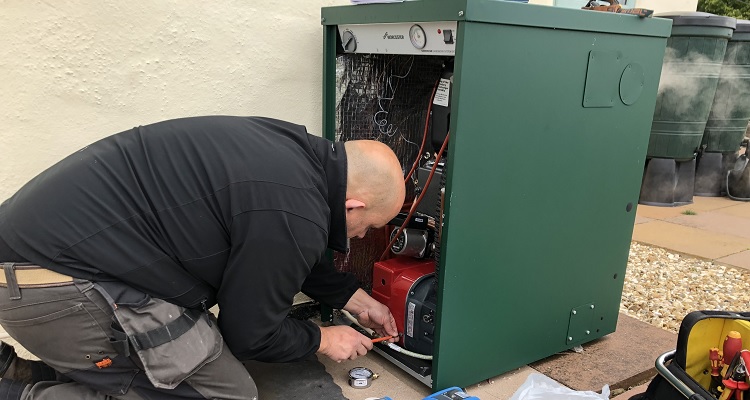
There is no law that states an oil boiler has to be installed by an OFTEC-registered engineer. However, it is not usually a DIY job.
The key legal requirement is that the installation complies with the Building Regulations. To do this, an OFTEC-registered installer can self-certify the work, or the installation can be notified to your local building control department for inspection and approval. Using a registered installer is the simplest way and thus the most common choice.
If you're replacing an old boiler, the engineer will have to come and assess the boiler and how to replace it, as well as help you decide what type of boiler is best for you, before they can give you an accurate quote.
By hiring an OFTEC-registered engineer to install your oil boiler, you will not only avoid potential damage, but you will save time and money.
The route you need to follow depends on where you live. In England, Wales, the Channel Islands and the Isle of Man, installers can use the self-certification scheme. Scotland has its own system through Approved Certifiers of Construction, while Northern Ireland handles the work through district council building control.
Are there any repairs on an oil boiler I can undertake DIY?
"The simple answer is no. Even though oil boiler repairs are not regulated like gas services are, you are still burning a fossil fuel and, therefore, if the correct air/fuel ratios are not achieved, then excessive emissions may occur.
Whilst most boilers these days are room sealed to the atmosphere, part of the service/repair schedule is checking and identifying any defects within the case seals of the combustion area. If these are defective, then products of combustion can enter the room / or spurious air being drawn into the combustion chamber, which could affect the combustion fuel/air mix.
Other than the reasons above, there are various electrical issues to attend to and be aware of. In any event, to ensure that the appliance is burning correctly and to the manufacturer's specifications, you need a flue gas analyser to prove the performance."
Whilst most boilers these days are room sealed to the atmosphere, part of the service/repair schedule is checking and identifying any defects within the case seals of the combustion area. If these are defective, then products of combustion can enter the room / or spurious air being drawn into the combustion chamber, which could affect the combustion fuel/air mix.
Other than the reasons above, there are various electrical issues to attend to and be aware of. In any event, to ensure that the appliance is burning correctly and to the manufacturer's specifications, you need a flue gas analyser to prove the performance."
Checklist: How to Find and Hire an Oil Boiler Engineer in the UK
When installing a new oil boiler, it's critical for your safety to hire an OFTEC-registered engineer to complete the fit.
Here's what we suggest when searching for your local engineer:
- Are they qualified? Check the engineer's OFTEC-registered status, and look at their past jobs to see if they've got a track record for similar projects.
- Are they insured? Confirm the engineer is insured, asking for proof of public liability insurance.
- Are they offering you a written quote? Always request a written quote, including all aspects of the work, with a fully itemised cost breakdown so there are no hidden charges.
- Can you check their past work? Look over their MyJobQuote profile to see your engineer's customer reviews, paying close attention to any comments on timekeeping, cleanliness on site, and overall quality.
- Do they offer certification? Once the work has been completed, make sure you get an OFTEC compliance certificate to certify the work.
We recommend that you gather at least 3 quotes from different OFTEC-registered engineers near you to compare costs.
Ask a Trade
Got a question that only a tradesperson can answer? We have thousands of trades ready to answer any question you may have.
Ask your question

FAQs
How Long Does an Oil Boiler Last and When Should You Replace One?
Oil boilers typically last between 10 and 15 years when well-maintained and professionally installed. Ensuring you have regular OFTEC-registered engineer services will help prolong your boiler's lifespan. If your boiler is over 20 years old, it is usually better and more cost-effective to replace it rather than repair it.
Do I Need Planning Permission to Replace or Relocate an Oil Boiler?
You won't usually need planning permission to replace an oil boiler with a like-for-like upgrade, but for brand-new oil boiler installations, or if you want to move your boiler to a new location, you may need to check with your local planning office first.
Planning permission is not needed in England for the oil tank either, as long as it holds under 3,500 litres, is under a certain height, is not in a front garden, and does not cover more than half of the grounds.
Are There Any Grants or Schemes Available for Oil Boiler Replacement in the UK?
There aren't government schemes available for installing oil boilers in the UK, but there are schemes for swapping fossil fuel systems with alternative heating systems, such as installing ground source heat pumps, or installing biomass boilers. These schemes are subject to change, though, so it's worth checking on an individual basis when you come to install your oil boiler.
Does Replacing an Old Oil Boiler Increase Property Value?
Installing an energy-efficient oil boiler in your property, installed by an OFTEC-registered engineer, has the potential to raise your home's value as it can positively affect your property's EPC rating, which is enticing for homebuyers.
Are Oil Boilers Cheaper to Run Than Gas Boilers?
Running costs for oil and gas boilers vary with current fuel prices, which fluctuate for both. Gas boilers are typically cheaper to run than oil, but oil is cheaper to run than electricity, making it cost-effective for home heating when you don't have a gas connection.
Are Oil Boilers Being Phased Out?
There is currently no ban in force on installing an oil boiler in an existing home, and nobody will be forced to remove an existing boiler. The Future Homes and Buildings Standards come into force on 24 March 2027 with a 12-month transition, but they set standards for new buildings, not for replacing a boiler in an existing home.