Builders
 Carpenters
 Electricians
 Flooring Specialists
 Gardeners
 Handymen
 Heating Engineers
 Painters & Decorators
 Plasterers & Renderers
 Plumbers
 Roofers
 Tilers
 my
myDisabled Lift in House Cost
At a Glance
- The average cost of a disabled lift installation is around £20,000.
- It typically takes between 1 and 5 days to install a disabled lift.
- Typical installed costs for each type of disabled lift.
- The labour, additional, and ongoing costs to budget for.
- Financial help, including the Disabled Facilities Grant and VAT relief.
- How to compare quotes from local lift installers with MyJobQuote.
Get free estimates
Are you a trade? Get more work today!
£20,000
Table of Contents
- How Much Does a Disabled Lift Cost to Install?
- Labour Costs to Install a Disabled Lift
- Additional Costs of Installing a Disabled House Lift
- Financial Help and Grants for Disabled Lifts
- Factors That Affect the Disabled Lift Price
- Types of Disabled Lifts
- Checklist: Hiring a Disabled Lift Installer
- FAQs
How Much Does a Disabled Lift Cost to Install?
The cost of installing a disabled lift in your home depends mainly on the type of lift you choose and whether it needs to carry a wheelchair.
At the lower end, a straight stairlift is the most affordable option. A through-floor lift with room for a wheelchair sits at the top of the range, costing up to £30,000.
What type of disabled lift are you looking to have installed?
Stairlift (straight or curved)
7 votes - 23%23% of votes
Wheelchair platform stairlift
9 votes - 30%30% of votes
Step or platform lift
2 votes - 7%7% of votes
Through-floor or vertical platform lift
12 votes - 40%40% of votes
I'm not sure yet
0 votes - 0%0% of votes

30 votes
See results
Hide results
Across all types, home lift prices generally range from around £2,000 to £30,000. The table below shows a broad range of typical installed costs for the main types of disabled lift in the UK.
Disabled Lift Prices
| Lift Type | Wheelchair Suitable? | Typical Installed Cost |
|---|---|---|
| Straight stairlift | No | £2,000–£5,000 |
| Curved stairlift | No | £4,000–£10,000 |
| Wheelchair platform stairlift | Yes | £8,000–£15,000 |
| Step or platform lift | Yes | £3,000–£6,000 |
| Vertical platform lift | Yes | £10,000–£20,000 |
| Through-floor home lift | Yes | £15,000–£30,000 |
Want a custom price?
Post your job
Wheelchair lifts generally cost more than standard stairlifts because they need a larger platform, higher weight capacity, and more space to operate safely.
Are there stairlifts that are suitable for narrow staircases?
"Yes, there are stairlifts that can be installed in narrow staircases although the minimum width the staircase can be is 750mm."
Labour Costs to Install a Disabled Lift
Most disabled lifts are sold as a supply-and-fit price, so labour is usually included in the total installed cost. However, more complex jobs, such as platform lifts and through-floor lifts, often involve longer fitting times and more specialist work.
A stairlift can often be fitted in a few hours. A through-floor lift usually takes 2 to 5 days, depending on the lift type, structural work, and access.
| Lift Type | Installation Time | Labour Day Rate | Total Labour Cost |
|---|---|---|---|
| Stairlift | A few hours | - | Included in price |
| Step or platform lift | 1 to 2 days | £150–£300 | £150–£600 |
| Through-floor lift | 2 to 5 days | £150–£300 | £300–£1,500 |
Want a custom price?
Post your job
Through-floor lifts usually take longer than this to install from start to finish, with additional time needed before the installation itself for the opening to be created and electrical and plumbing supplies to be rerouted. The total time needed to install this system can be up to 2 weeks.
Additional Costs of Installing a Disabled House Lift
On top of the lift itself, a few extra costs can affect the final price of the project:
- Structural and Building Work — Through-floor lifts usually need an opening cut between floors, and floors or load-bearing walls may need reinforcing, which adds to the cost.
- Survey and Assessment — A site survey, and sometimes an occupational therapist assessment, checks your home's layout and confirms the right lift type for your needs.
- Making Good and Finishes — Plastering, redecoration, and relaying flooring such as laminate flooring around the new opening are often needed after installation.
- Custom Finishes — Upgraded rails, seats, doors, or trims to suit modern homes add to the price.
- Building Control and Permissions — Fees may apply for building regulations sign-off, and listed buildings or homes in a conservation area can cost more.
- Electrical Upgrades — Some installations need electrical work, such as adding a dedicated power supply, moving sockets, or upgrading wiring near the lift position.
- Ongoing Maintenance — Annual servicing and regular maintenance keep the lift safe and compliant, so budget for them as a long-term cost.
Disabled lifts are often fitted as part of wider home adaptations. Where someone has mobility issues, other changes can improve independence too, such as smart lighting or a smart thermostat for easier control of the home. For ground-floor living, some families also weigh up a granny annexe.
Can a lift be installed in any home? My elderly parents want one instead of a stairlift, but are there limitations or considerations we should know about?
"The only concern is the allocation of space. A small lift can be installed in a home as long as there is enough room for this, but the floor may need to be reinforced.
The type of lift would be similar to what you find in a shopping area — a single storey lift. If it's a multiple storey lift, this is where the complications would arise as there are more regulations required for this."
The type of lift would be similar to what you find in a shopping area — a single storey lift. If it's a multiple storey lift, this is where the complications would arise as there are more regulations required for this."
Financial Help and Grants for Disabled Lifts
You may not have to cover the full cost yourself. There is financial help available for adapting a home for a disabled person, and the main route is the Disabled Facilities Grant.
Disabled Facilities Grant
The Disabled Facilities Grant is a grant from your local council that helps pay for home adaptations, including lifts. In England, you can apply for up to £30,000, Wales offers up to £36,000, and in Northern Ireland the grant is up to £25,000. The grant is means-tested on household income and savings above £6,000, although disabled children under 18 can qualify without their parent's income being tested.
Scotland handles adaptation support through local councils rather than the Disabled Facilities Grant scheme.
Eligibility criteria apply, and an occupational therapist usually assesses the need. The grant can also fund other adaptations, such as a wet room.
VAT Relief
You can claim VAT relief on installing, maintaining, and repairing a disabled lift but you must give your supplier and installer written confirmation before you pay, as HMRC can't refund the VAT to you after the fact.
Those who are chronically sick or disabled are eligible for 0% VAT, and those over 60 who are not chronically sick or disabled qualify for a reduced rate of 5% VAT.
Charitable and Local Support
Some charities and local council schemes offer extra financial help towards mobility equipment. An occupational therapist or social services team can point you towards the options you may be able to claim.
Factors That Affect the Disabled Lift Price
Several factors explain why two quotes for a disabled lift can look very different:
- Type of Lift — A straight stairlift is far cheaper than a through-floor or platform lift.
- Number of Floors — Serving two floors, or multiple floors in multi-storey homes, raises the price.
- Drive System — Hydraulic, traction, and air-driven systems differ in price, and some need a separate machine room while others do not.
- Layout and Space — Limited space, tight or curved staircases, and the need for a lift shaft all affect the cost.
- Structural Work — Reinforcing floors or load-bearing walls adds to installation complexity and the final cost.
- Finishes and Features — Custom finishes, advanced safety features, and a smoother, quieter ride all push the price up.
- Location — Labour rates vary across the UK, and listed buildings or a conservation area can cost more.
- Servicing — Annual servicing and warranty terms shape the long-term cost of ownership.
Types of Disabled Lifts
There are several types of disabled lift, and the right one depends on your home's layout, whether you need wheelchair access, and your budget.
Disabled Stairlift
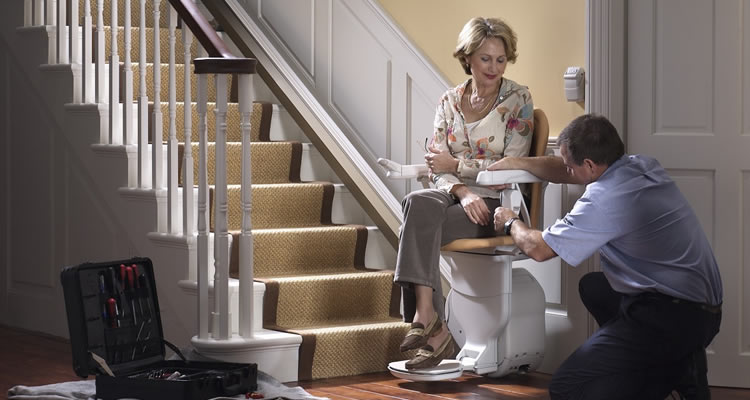
A stairlift carries a seated user up the stairs on a rail fitted to your staircase. Straight stairlifts suit straight flights, while curved ones are made to measure for stairs with bends or a landing.
If the stairs themselves need work first, see our staircase renovation cost guide. For someone who only needs light support, a new handrail may be a simpler option.
Pros
- ✔ Lowest-cost option
- ✔ Quick, less disruptive installation
- ✔ Suits most staircases
Cons
- ✖ Not suitable for wheelchair users.
- ✖ Curved models cost more.
- ✖ Takes up some stair width.
Wheelchair Platform Stairlifts
An inclined platform lift runs along the staircase and carries a wheelchair and user together. It is best for wheelchair users who want to stay on one staircase without major building work, although it does need enough staircase width.
They usually cost more than standard stairlifts because the platform needs to support both the wheelchair and the user, but they can avoid the need for a larger through-floor lift.
Pros
- ✔ Less invasive than through-floor lifts
- ✔ Allows for a carer to accompany the user
- ✔ Relatively inexpensive
Cons
- ✖ Not suitable for all staircases.
Step and Platform Lifts
Short-rise platform lifts raise a wheelchair user over a few steps or between split levels. They suit doorways, porches, and split-level homes with limited space, and they are a cost-effective choice where only a small rise is needed.
They are usually cheaper than full through-floor lifts, but they only work where the height difference is small.
Pros
- ✔ Fairly inexpensive
- ✔ Quick installation
Cons
- ✖ Only work for small height differences.
- ✖ Multiple may be needed if the home has several split levels.
Through-Floor and Vertical Platform Lifts
A through-floor lift travels between two floors through an opening in the ceiling, often without a separate machine room. Vertical lifting platforms do the same job in a compact, self-contained unit. Both are best for wheelchair users who need full access between floors.
Pros
- ✔ Full wheelchair access between floors.
- ✔ Smooth, quiet ride.
- ✔ Can future-proof the home for changing mobility needs.
Cons
- ✖ Highest cost
- ✖ Needs structural work
- ✖ Takes floor space on both levels
Checklist: Hiring a Disabled Lift Installer
- Relevant lift experience — Choose an installer who regularly fits the type of lift you need, whether that's a stairlift, platform lift, or through-floor lift.
- Safety accreditation — Home lifts carry a statutory safety obligation, so check the installer works to the relevant lift and safety standards.
- Site survey first — Make sure they assess your staircase, floor structure, and available space before giving a price.
- Clear, itemised quote — Confirm what's included, such as structural work, finishes, controls, and removal of any old equipment.
- Insurance and warranty — Ask about public liability insurance and check the warranty terms on both the lift and the installation.
- Servicing and aftercare — Check whether annual servicing and maintenance are offered, as lifts need regular inspections.
- Reviews and references — Read recent reviews and ask to see examples of similar installations.
- Compare multiple quotes — Get at least three quotes so you can compare price and service. MyJobQuote can connect you with lift installers near you.
Ask a Trade
Got a question that only a tradesperson can answer? We have thousands of trades ready to answer any question you may have.
Ask your question

FAQs
Do Through-Floor Lifts Have to Be Serviced?
Yes, through-floor lifts should be serviced regularly. Servicing helps spot worn parts, sensor issues, and safety faults before they become more expensive to repair. Ask your installer for the annual service cost before agreeing to the installation.
Which Is Better, a Stairlift or a Through-Floor Lift?
A stairlift is usually the cheaper option, especially if you only need seated support on a straight staircase. A through-floor lift costs more because it needs more space, more specialist installation, and often structural work. However, it may be the better option if the user cannot safely transfer to a stairlift.
Can I Install a Disabled Lift Myself?
No, disabled lifts should be installed by a specialist. A DIY installation could lead to safety issues, failed sign-off, warranty problems, and expensive remedial work. Professional installation is usually included in the supply-and-fit price.
Do I Need Planning Permission to Fit a Disabled Lift?
Most internal disabled lift installations do not need planning permission, so this may not add to the cost. However, listed buildings, conservation areas, or external changes can involve extra fees, drawings, or delays, so check this before accepting a quote.
Do Disabled Lifts Need to Meet Building Regulations?
Yes, most home lifts must meet building regulations where structural changes, electrical work, or a new opening between floors are involved. This can add survey, building control, and sign-off costs, so check whether these are included in your quote.
What Is the Cheapest Disabled Lift to Install?
A straight stairlift is usually the cheapest disabled lift option, with typical installed costs from around £2,000 to £5,000. Step or short-rise platform lifts can also be lower-cost options if you only need to cover a small change in level.
How Much Does It Cost to Service a Home Lift?
Home lift servicing costs vary depending on the lift type, service plan, and whether replacement parts are needed. Ask for the annual maintenance cost at quote stage so you can budget for the long-term cost of owning the lift.
Can Financial Help Reduce the Cost of a Disabled Lift?
Yes, financial help may reduce the amount you need to pay yourself. The Disabled Facilities Grant, VAT relief, local council support, and some charities may help with eligible home adaptations. Check what you can apply for before starting the installation.