Builders
 Carpenters
 Electricians
 Flooring Specialists
 Gardeners
 Handymen
 Heating Engineers
 Painters & Decorators
 Plasterers & Renderers
 Plumbers
 Roofers
 Tilers
 my
myConcrete Driveway Cost
At a Glance
- The average cost to lay a concrete driveway is around £6,200.
- The job will usually take between 3 and 5 days to complete.
- NEW! Use our concrete driveway cost calculator for an instant estimate.
- A complete pricing information breakdown, including what cost factors you need to consider and what such a job usually entails.
- How long the job will typically take, and a general overview of what kind of jobs can be performed.
- How to find and hire a driveway paver using MyJobQuote.
Get free estimates
Are you a trade? Get more work today!
Trying to find out how much a concrete driveway costs to lay?
In this guide, we break down concrete driveway prices, including stamped concrete driveway prices and imprinted concrete price for your driveway.
After reading this guide, anyone should be able to calculate the cost of new driveway installation.
Depending on the size and style of driveway that you're looking for, you should expect to pay between £2,500 and £11,500 for installation. The average cost of a concrete driveway in 2026 is £6,200.
Are you ready to get a quote for your job?
If so, we have a range of driveway pavers ready to give you a free quote!
So, take a look!
£6,200
Table of Contents
- How Much to Concrete a Driveway?
- Supply Costs of a Concrete Driveway
- Labour Cost of a Concrete Driveway
- Additional Concrete Driveway Costs
- What Impacts Concrete Driveway Costs?
- What's Involved in Installing a Concrete Driveway?
- Is My Driveway Suitable for Concreting?
- Benefits of a Concrete Driveway
- Patterned Concrete Driveway Cost
- Pressed Concrete Driveway Cost
- Exposed Aggregate and Coloured Concrete Driveway Costs
- Concrete Driveway Alternatives
- Building Regulations for Concrete Driveways
- Cleaning and Maintaining a Concrete Driveway
- Cost of Concrete Driveway Removal
- Checklist: Hiring a Concrete Driveway Tradesperson
- FAQs
How Much to Concrete a Driveway?
A concrete drive is a great place to park your car to get it off the street, but it is also a great way to transform your home. It improves the first impression of your property, and can even add value to the home.
Private parking is especially beneficial if you live in a busy area and you are continually fighting with your neighbours for a parking spot by your home.
However, not all driveways are cheap. A concrete driveway is a common choice, as they look smart and come in a number of styles.
They are a popular option thanks to their durability, neat appearance, and long lifespan.
So, how much does it cost to concrete a driveway?
The average cost to lay a concrete driveway is around £6,200 for a 60m² driveway with standard features and no excessive groundwork requirements.
Can I widen my concrete driveway without replacing or resurfacing the existing drive?
"Yes, of course, you just need to ensure the widened part is fixed to the existing, normally with some re-bar to strengthen it and stop it breaking away. It's a very common practice that we’ve conducted many times in the past."
Concrete Driveway Prices
Below is a table highlighting the prices you should expect to pay to have a simple concrete driveway installed at your home.
| Job Description | Duration | Material Cost | Labour Cost | Total Average Cost |
|---|---|---|---|---|
| Concrete Driveway (30m²) | 2 to 3 days | £1,500–£2,200 | £1,000–£1,800 | £2,500–£4,000 |
| Concrete Driveway (60m²) | 3 to 5 days | £3,000–£4,200 | £2,000–£3,300 | £5,000–£7,500 |
| Concrete Driveway (90m²) | 5 to 7 days | £4,500–£6,000 | £3,000–£5,000 | £7,500–£11,000 |
Want a custom price?
Post your job
If you are looking for something a bit more extravagant, or if you have a lot of space to work with, then you may be interested in having an imprinted concrete driveway installed at your home.
Below is a table indicating the costs that you should expect to pay for an imprinted concrete driveway.
| Job Description | Duration | Material Cost | Labour Cost | Total Average Cost |
|---|---|---|---|---|
| Patterned Concrete Driveway (30m²) | 3 to 4 days | £1,900–£2,400 | £1,600–£2,100 | £3,500–£4,500 |
| Patterned Concrete Driveway (60m²) | 5 to 6 days | £3,400–£4,200 | £2,800–£3,800 | £6,200–£8,000 |
| Patterned Concrete Driveway (90m²) | 6 to 8 days | £4,900–£6,000 | £4,100–£5,500 | £9,000–£11,500 |
Want a custom price?
Post your job
Concrete Driveway Cost Calculator
Supply Costs of a Concrete Driveway
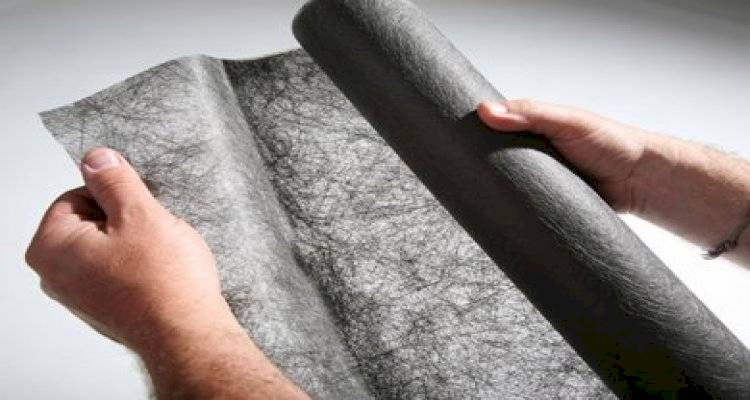
The main supply cost for a concrete driveway is the concrete itself, but additional materials such as reinforcement mesh, hardcore, edging, and membranes may also be needed depending on the ground conditions and finish required.
- Concrete — £50 to £75 per m².
- Sub-Base Aggregate / Hardcore — £15 to £25 per m².
- Steel Reinforcement Mesh (if Required) — £10 to £20 per m².
- Edging Blocks — £15 to £40 per linear metre.
- Weed Membrane — £2 to £5 per m².
- Skip Hire — £240 to £550.
- Mini-Digger Hire — £150 to £220 per day.
Labour Cost of a Concrete Driveway
Let's take a closer look at labour costs and timescales for this type of job.
The average cost for the labour of installing a concrete driveway falls somewhere between £33 and £55 per m². Depending on the complexity of the job, you would be looking to pay an average of £300 to £500 per day for labour, depending on team size (usually at least two workers will be involved) and machinery required.
A small driveway for one car can take as little as 2 days to complete, whereas a larger driveway for 4 cars will take closer to a week to complete. It is important to keep this in mind when looking into the labour costs, especially if the company charges a daily rate.
Additional Concrete Driveway Costs
There are a number of additional costs that may come up when you install a new concrete driveway. Below are some of the additional costs that you may need to consider when having your new driveway installed.
- New Driveway Gate — £550 to £1,200.
- Security Light — £15 to £500.
- New Garden Wall — £900 to £1,400.
- New Garden Fence — £600 to £1,750.
- Landscaping — £95 to £180 per m².
- CCTV System — £275 to £950.
Ask a Trade
Got a question that only a tradesperson can answer? We have thousands of trades ready to answer any question you may have.
Ask your question

What Impacts Concrete Driveway Costs?
A number of cost factors can affect the overall price you pay to have a concrete driveway installed at your home.
What concrete driveway feature do you consider most important?
Durability and long-lasting
1 votes - 25%25% of votes
Low maintenance and easy to clean
2 votes - 50%50% of votes
More affordable and budget-friendly
1 votes - 25%25% of votes
Overall appearance or design
0 votes - 0%0% of votes

4 votes
See results
Hide results
- Driveway Size — a 30m² concrete driveway usually costs around £2,500 to £4,000, while a 90m² driveway may cost around £7,500 to £11,000, depending on the finish, site conditions, and preparation work required.
- Existing Groundwork — installing a completely new driveway from scratch usually costs more than replacing an existing driveway that already has a suitable base in place, since removal work adds to the job.
- Professional Installation vs DIY — hiring a professional adds labour costs, whereas carrying out the work yourself can save considerably on this part of the job.
- Finish Style — a simple small driveway can cost between £1,500 and £2,200 (excluding labour), whereas a small patterned driveway will cost around £1,900 to £2,400 (excluding labour).
- Location — labour and material costs tend to run higher in London and the South East than in other parts of the UK, so quotes can vary noticeably by region.
Thin shards of concrete have cracked and come loose from the surface of my drive. What can I do about it?
"This is because the concrete has not been made using the right sealing material, and potentially not enough metal rebar supporting the mix."
What's Involved in Installing a Concrete Driveway?
Below is a list of the steps that are involved in laying a concrete driveway.
Step One
The first step when installing a new concrete driveway is to lay out the perimeter of your driveway with wooden stakes. Once you have the shape and dimensions correct, drive the stakes into the ground at regular intervals and ensure the final outline matches up with your planned driveway size.
Step Two
Use some sturdy wooden planks to create a solid, temporary housing for your new driveway. These wooden planks will keep your concrete in place when it is poured. You must ensure these planks are anchored in so that they are consistently aligned and stay straight throughout the process of building your driveway.
Step Three
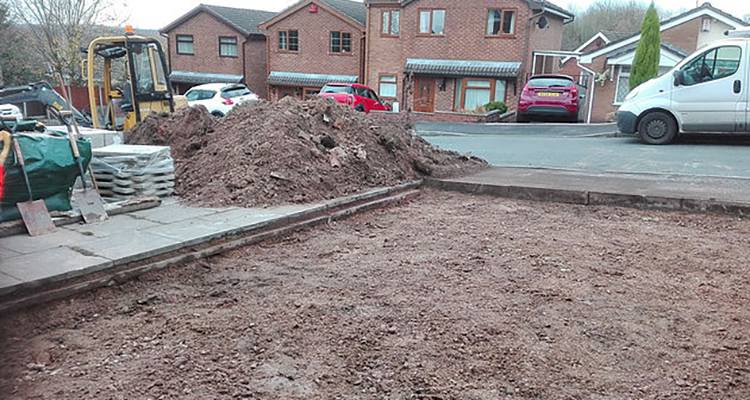
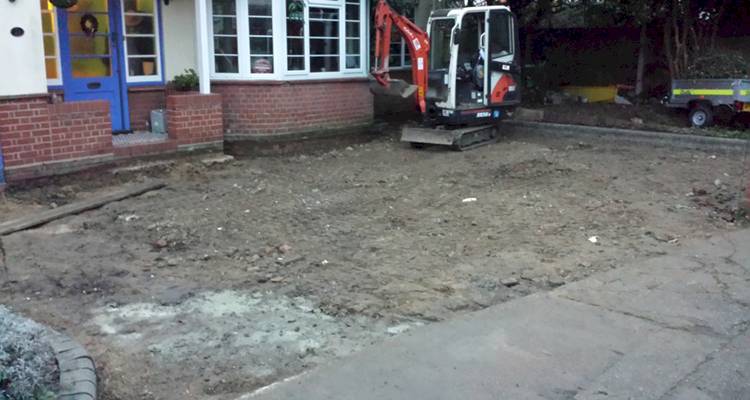
You must now dig out the topsoil and level out the driveway sub-base. You must have a level foundation. Be sure to dig out the top level so that it's at your required depth.
If the sub-base is not suitable at this level, dig 4 more inches and add your hardcore. This will need to be compacted to prevent the concrete from cracking. This firmly compacted layer will provide a solid foundation upon which your concrete can be poured.
Step Four
If necessary, you may want to reinforce your driveway with steel to make it much stronger. This will enable you to handle heavier loads with ease. To do this, you need to install reinforcing steel bars in a grid-style pattern all over your pour site.
You can buy dedicated concrete mesh made from steel for this purpose. If you reinforce your concrete with steel mesh, this will help to distribute the weight of your vehicles more evenly. The steel mesh will drastically improve the strength of your driveway.
Step Five
Now that all the foundations are set up, you need to wait for your concrete to arrive. Ready-mixed concrete needs to be poured as soon as it arrives at the worksite. Pour your concrete in even loads.
As you are pouring it, you can distribute the concrete with a hoe. Keep the concrete relatively flat and pour it until it is slightly higher than the top of the forms.
Step Six
Once you have poured the concrete, you will need to flatten it to create a consistent, smooth surface. Begin by removing any excess concrete so that the end result is level with the planks.
Do this with a straight timber 2x4. Start at one end of the driveway and place the timber horizontally across a slab. Move it backwards and forwards in a steady sawing motion to flatten all of the concrete out. Use any of the excess concrete to fill in any shallow areas as you go along.
Then, use a concrete float to smooth out the surface. Starting at one end, place your float against a horizontal plank and use a smooth arching motion to flatten and smooth out the surface. Continue this across the driveway until the entire surface is consistently smooth.
Step Seven
You will now need to use a concrete grooving tool to cut control joints into your driveway. For a driveway that is 4 inches deep, space these joints 2.4m to 3m apart, with 4.5m as the maximum, and keep each bay roughly square, as long, narrow bays are more likely to crack in the middle.
The joints should be cut to roughly 1 inch deep and should be cut along the entire width of the driveway. Contraction joints are useful in controlling the expansion and contraction of the concrete slab as it dries.
Step Eight
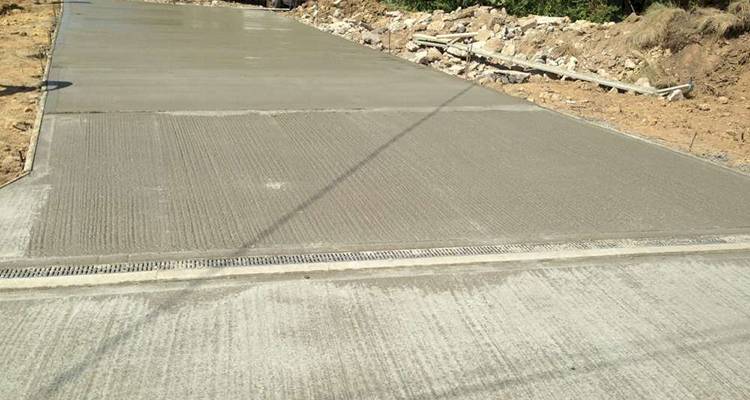
To allow traction for your vehicle, you will need to add a non-slip finish to your driveway. Use a thick-bristled broom for this part of the job. Simply run your broom over the driveway evenly from one side of the drive to the other.
Repeat this until your entire driveway has been run over by the broom. Be sure to stick in one consistent direction for each stroke.
Step Nine
The concrete will need to be cured for some time before it is fully ready to take on the weight of your vehicle. It should be left to cure for around 7 to 10 days after laying the concrete.
Curing can be done by creating a moisture-retaining barrier. This can include regular sprinkling, laying down wet curing blankets, or layering plastic sheeting.
Step Ten
Once you have begun curing your driveway and the concrete slab has hardened, you can now remove your wooden planks.
Remove the stakes first and then remove the wooden planks one at a time. Take your time during this step, and be careful not to cause damage when removing the wood.
Step Eleven
This is an optional step. If you would like to, you can create a smooth finish to the edges of your driveway. You will need to use an edging tool for this. Start at one end of the driveway and work along it.
Make sure that you keep either the front or back of the tool raised slightly so that you are not pushing the concrete down. Use a smooth motion right the way along the edge of the concrete slab to shape it.
Step Twelve
The last step is to begin using your driveway. Usually, the concrete won't fully reach its curing strength until a minimum of 28 days after the concrete has been poured.
You should be able to safely walk across the concrete after 2 days. However, it is best to avoid parking on it for at least 28 days.
How long do imprinted concrete drives tend to last?
"If good quality concrete is used and it’s maintained - ie sealed every year - you should get around 25 years without issues."
Below is a list of what is involved in the job when installing a patterned concrete driveway to your home:
- Locate any existing cables and pipes.
- Excavate the ground to the required depth as needed.
- Install any drainage that is required.
- Compact the lower layer to a level surface.
- Lay a membrane to prevent weeds.
- Add a sub-base granular material and compact it.
- Lay reinforcements if required.
- Pour the wet concrete down.
- Apply colourant as desired.
- Stamp your chosen pattern into the concrete before it dries.
- Add adequate crack prevention gaps.
- Once the surface is dry, it should be cleaned and sealed with a translucent sealer.
Is My Driveway Suitable for Concreting?
To lay a concrete driveway, you will need to remove whatever is on the top layer of the site. This may be grass, an old driveway, or even just dirt.
You can check if the ground is suitable using the peg test. Push a 50mm wooden peg into the soil, and if it sinks past 150mm with very little resistance, the ground is too soft to build on without advice.
You will need to dig down about 200mm to 250mm in total, including about 150mm of compacted sub-base laid over a geotextile membrane, with the concrete slab on top. If the ground is poor quality, you may need to dig deeper and fill any soft spots with more sub-base material.
Before concreting, you will need to ensure there are no weeds on the site, and if there are, these will need treating with weed killer.
Benefits of a Concrete Driveway
There are several advantages of having a concrete driveway installed at your home. Below are some of the main benefits.
Good Long-Term Investment
A concrete driveway lasts a very long time. With this in mind, it is a good investment in the long term. How long a concrete driveway lasts depends on the quality of the build and how well the joints are looked after.
Low Maintenance
Unlike gravel driveways, a concrete driveway requires very little maintenance. Just a simple clean every now and again is enough to keep your concrete driveway in tip-top shape.
Durable and Strong
Concrete is an extremely durable surface and so will last a very long time. The strength means that it will be able to withstand the heaviest of your vehicles.
Value-Adding Enhancement
By adding a concrete driveway to your home, you can increase the value of your property.
How frequently do you suggest I have an imprinted concrete driveway resealed?
"It is recommended that pattern imprinted concrete would benefit from a reseal every 3 to 5 years. This will maintain a protective coating on top of the pattern-imprinted concrete."
Patterned Concrete Driveway Cost
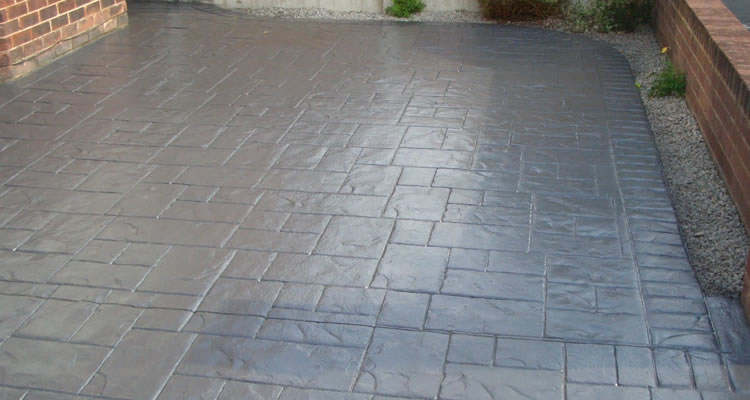
Patterned concrete, also known as stamped or imprinted concrete, is a great choice for a driveway because it ticks every box. It's durable, affordable, low maintenance, and it also provides a unique and personal style to your home.
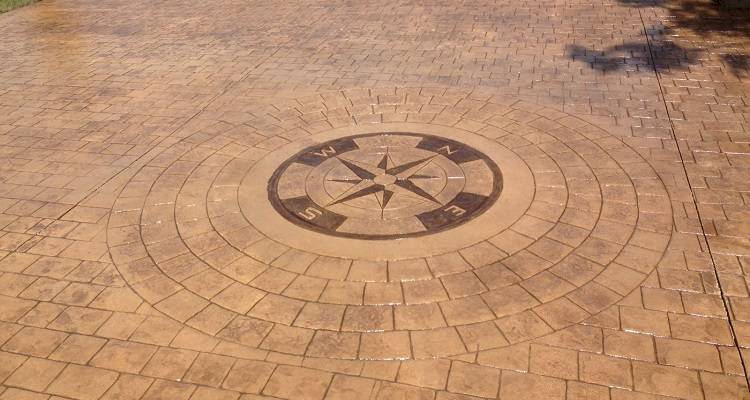
The best thing about a patterned concrete driveway is that it's entirely customisable and there are hundreds of different patterns to choose from. This includes the main pattern of the driveway, and also the border and edging pattern.
There are also a huge number of different colours that you can choose from for your patterned concrete driveway.
Depending on the colour and pattern that you choose to have installed, materials alone typically cost around £55 to £80 per m², with a fully installed price of £100 to £130 per m² once labour is included. For a complete pricing breakdown, see our imprinted concrete driveway cost guide.
Pressed Concrete Driveway Cost
A pressed concrete driveway involves pressing a unique pattern into the concrete while it's still wet. There are unlimited options when it comes to pressed concrete. Not only are the patterns unlimited, but you can also have coloured concrete to make it completely unique.
Pressed concrete is different from a simple flat concrete as it involves creating a unique pattern for your driveway. Many contracting companies will offer a variety of different patterns and colours for you to choose from.
A standard concrete driveway will usually have material costs of around £50 to £75 per m², while pressed or patterned concrete typically costs £100 to £130 per m² fully installed, due to the colourants, finishing work, and decorative imprinting involved.
Exposed Aggregate and Coloured Concrete Driveway Costs
Alongside patterned and pressed finishes, exposed aggregate and coloured concrete are popular ways to add texture or personality to a plain concrete driveway.
Exposed aggregate concrete is finished by removing the top layer of cement paste to reveal the decorative stone underneath, creating a textured, non-slip surface. This typically costs £70 to £100 per m², depending on the type of aggregate used and how much of it is exposed.
Coloured concrete uses pigment mixed through the concrete, or applied to the surface, to change its appearance without a raised pattern. Adding colour typically adds £15 to £25 per m² on top of standard concrete pricing.
Concrete Driveway Alternatives
There are many different styles of driveway. Below is a list of alternative driveway options if you are looking for something other than concrete.
Brick Block Paving Driveway Cost
A block paving driveway is a favourite among British homeowners. Bricks come in a variety of colours and can even be customised to reflect your own unique personality and style.
A brick driveway costs around £70 to £120 per m² (including installation costs).
Pros
- ✔ Bricks come in a variety of colours and styles.
- ✔ The driveway can be made unique to your style.
- ✔ Gives a clean, polished aesthetic.
Cons
- ✖ Can be quite expensive to install.
Tarmac Driveway Cost
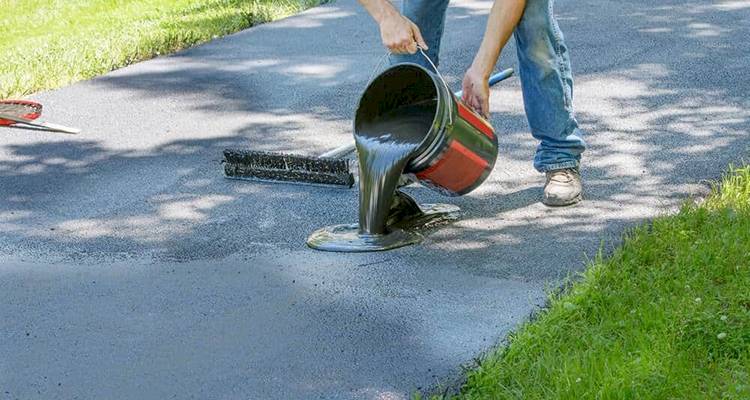
Tarmac driveways are another popular choice due to being very easy to install. This means that the installation costs are a lot less than those of other driveway styles.
Tarmac usually comes in black, which is the cheapest option, but coloured asphalt is also available, using pigment, coloured stone, or decorative chippings rolled into the surface as it's laid. A tarmac driveway costs around £45 to £80 per m² (including installation costs).
Pros
- ✔ Cheap to purchase.
- ✔ Easy to install.
Cons
- ✖ Colour costs more than standard black.
- ✖ Can soften in hot weather.
Gravel Driveway Cost
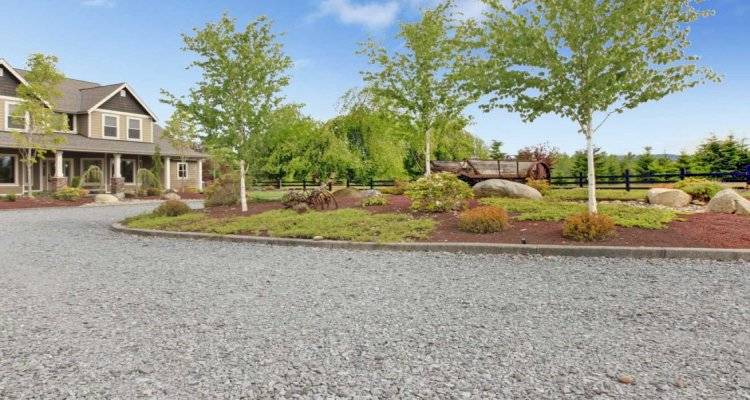
A gravel driveway is a relatively well-priced option due to gravel being readily available. It comes in a variety of different colours so you can choose a driveway that perfectly suits the theme of your home.
A gravel driveway costs around £40 to £70 per m² (including installation costs).
Pros
- ✔ Good price in comparison to other driveway styles.
- ✔ Comes in a variety of colours.
- ✔ Relatively easy to install.
Cons
- ✖ Gravel stones can shift a lot over time.
Crushed Stone Driveway Cost
A crushed stone driveway is similar to a gravel driveway, but with a smoother surface. It also comes in a variety of colour options so you can get the desired effect for your home.
A crushed stone driveway usually costs around £40 to £75 per m² (including installation costs).
Pros
- ✔ Provides a smooth surface.
- ✔ Comes in a variety of colours.
- ✔ Relatively easy to install.
Cons
- ✖ Stones can shift and move over time.
Basalt Driveway Cost
Basalt offers a unique driveway look, and it also benefits from being very low maintenance. However, it is very difficult to install and will require a specialist contractor to ensure that it turns out right.
A basalt driveway usually costs around £85 to £130 per m² (including installation costs).
Pros
- ✔ Beautiful aesthetic
- ✔ Easy to maintain
Cons
- ✖ Difficult to install.
- ✖ Requires a specialist installation team.
- ✖ Can be quite expensive.
Cobblestone Driveway Cost
A cobblestone driveway is a timeless design that comes with a wide range of different design choices. It is incredibly durable and requires very little maintenance. However, it is very difficult to install and will require a specialist to ensure that the job is done right.
A cobblestone driveway usually costs around £115 to £200 per m² (including installation costs).
Pros
- ✔ Great timeless look
- ✔ Comes in a variety of styles
- ✔ Incredibly durable
Cons
- ✖ Requires a specialist installation team
- ✖ Quite expensive
Building Regulations for Concrete Driveways
Usually, you don't need to worry about any building regulations when it comes to installing a concrete driveway. Therefore, you are not required to apply for building regulations approval before you start performing work on your home driveway.
However, there are some specific rules that apply if you are looking to alter your driveway. The regulations state that any changes you make to your driveway should not have an adverse effect on the ability to access the house that it is connected to.
This means that any alterations to your driveway should make accessing the building better or leave it at the same standard that it was before the work was carried out. You also need to ensure that your driveway has adequate drainage.
If you live in a listed building, you should apply for listed building consent ahead of any work taking place. You may also need to undergo extra planning regulations preparation if your property is in a national park, a conservation area, or a world heritage site.
If your home falls under one of these categories, contact your local authority for more information on whether you need any form of consent to install your new driveway.
Standard concrete is a non-permeable surface, so planning permission may be required if your front driveway covers more than 5m² and doesn't drain to a permeable area. There's no size limit behind or beside the house, and in Scotland, any front hard surface must be permeable regardless of size. If your driveway includes a soakaway or other suitable drainage within your property, permission usually isn't needed. Check with your local authority if you're unsure.
Cleaning and Maintaining a Concrete Driveway
A concrete driveway doesn't require a vast amount of maintenance. However, to preserve the appearance of your concrete driveway and for it to last as long as possible, there are a few things that you can do.
Below is a list of tips on how to maintain your new concrete driveway.
Clean and Reapply Concrete Driveway Sealer as Necessary
One of the best measures in maintaining your concrete driveway is cleaning it and keeping it sealed. Reseal your concrete driveway once it stops beading water or starts to look patchy, and keep the joints sealed too, as open joints let water into the base and weaken the support for the slab.
Good sealers are available from most DIY stores and cost around £55 to £110 per 20 litre pot.
Remove Stains Immediately
A sealer will protect your driveway from absorbing stains. However, it is still a good idea to remove them as soon as possible. If the concrete does discolour from a spillage, a pressure washer will remove most stains.
You can purchase a pressure washer at most home goods stores, and they cost on average £90 to £220.
Treat Your Driveway with Care
Concrete is one of the most durable paving materials for a driveway. However, a typical concrete driveway isn't built to withstand very heavy weight. This can include large vans and construction equipment.
With this in mind, avoid driving or parking any heavy vehicles on your driveway. You should also take care not to scratch the surface of your driveway with metal tools or sharp objects.
Cost of Concrete Driveway Removal
You may want to remove a concrete driveway to make way for a new driveway or to build a garden instead.
Breaking up a concrete driveway is not an easy task and will take a lot of work. With this in mind, it is highly recommended that a professional contractor or company is hired to complete the job.
To break up a concrete slab, you will need a heavy-duty tool such as a jackhammer or a demolition hammer. These can be purchased from a DIY store or online and cost around £180 to £1,100+ depending on the strength of the tool.
You will also need to have a shovel on hand so that you can remove all of the waste materials. You would most likely need to hire a skip for the waste removal. A one-week skip hire will cost you around £220 to £280.
If you are looking to hire a professional to remove your concrete driveway, you would be looking to pay around £600 to £1,700 depending on the size of your driveway, and the job can usually be completed within 1 to 2 days.
This price includes the cost of labour as well as all of the materials needed to complete the job.
What's the best tool for breaking up the surface of an old concrete driveway?
"An electric breaker with a pointed chisel is best for breaking up concrete."
Checklist: Hiring a Concrete Driveway Tradesperson
Finding the right person to install your concrete driveway is crucial, and as such, we've pulled together some key tips to help you find that perfect tradesperson:
- Have you asked for personal recommendations? If someone you know has recently had a concrete driveway laid, ask about their experience. Seeing the finished work first hand can provide a solid assessment of the professional's skills and reliability.
- Do they have positive reviews? Checking platforms such as their MyJobQuote profile allows you to see how previous customers rate the tradesperson for the quality of their work. Written testimonials from recent clients are a strong indication of what to expect.
- Are they able to provide examples of their work? Even if you've seen a completed job at someone else's house, if a company is able to provide further examples or a portfolio of work, this can give you more of an idea of the finishes and patterns available.
- How much experience do they have? While choosing a tradesperson based on how long they've been in business isn't always the best measure alone, it often goes hand in hand with the quality of their work. Check how long they've been established and how much work they currently have on.
- Have you compared multiple quotes? It's often recommended to ask for several quotes from different contractors to help ensure you're paying a fair price. MyJobQuote suggests three quotes and can provide you with these from tradespeople in your area without any obligation.
- Have you received a detailed breakdown? As well as an itemised quote covering excavation, sub-base installation, materials, labour, and waste removal, it's good to have any agreed work confirmed in writing. This prevents any confusion and also helps avoid hidden expenses, such as knowing upfront whether drainage work or decorative edging is already included.
- Do they have public liability insurance? Although not a legal requirement, it's often considered essential among companies and reputable tradespeople. Public liability insurance covers against personal injury and accidental damage.
FAQs
What Is the Cheapest Type of Driveway Material in the UK?
Gravel and tarmac are often among the cheaper driveway options overall, while standard concrete usually costs more but offers a durable and long-lasting finish.
Is a Concrete Driveway Cheaper Than Tarmac?
Tarmac is generally the cheaper option, typically costing £45 to £80 per m² installed, compared with £50 to £75 per m² for standard concrete supply alone before labour. Concrete usually costs more upfront, but it can last longer with proper care, which may offset the difference over time.
How Much Does a 2 Car Driveway Cost per m²?
A typical two-car driveway measures around 60m². Based on average material and labour costs, this works out to roughly £85 to £125 per m², or £5,000 to £7,500 in total for a standard concrete finish.
What Are the Disadvantages of a Concrete Driveway?
Concrete driveways can be prone to cracking over time, particularly with ground movement or heavy loads, and repairs can be difficult to blend in with the surrounding surface. The initial cost is also higher than options like gravel or tarmac, and colour or pattern changes can't easily be made once the concrete has been laid.
How Thick Should a Concrete Driveway Be?
Most residential concrete driveways are laid at a depth of around 10cm (4 inches). Driveways expecting heavier loads, such as vans or multiple vehicles, may need extra depth or additional reinforcement to prevent cracking.
When Can You Drive on a Fresh Concrete Driveway?
It is recommended that you wait a minimum of 28 days before you begin driving and parking on your new concrete drive. This allows the concrete time to set into place and reach its full strength.
Will a New Concrete Driveway Add Value to My House?
A new concrete driveway can add value to your house. This is particularly true if you are adding a brand-new driveway to a home that previously didn't have a driveway. Off-street parking is something buyers often notice, which can make a home more appealing when selling.
Can I Concrete a Driveway Myself?
It is possible to concrete your driveway yourself as a DIY project. However, it is a very big job that requires a lot of work. With this in mind, we do recommend hiring a professional contractor to carry out the work.
What Is the Cost of Patterned Concrete?
Depending on the style you choose, a patterned driveway will cost you around £55 to £80 per m² for materials alone (excluding labour), or £100 to £130 per m² fully installed.